Have you ever noticed that often, when asked how work or general life is going, the typical response is ‘good’ followed commonly by ‘busy’? This answer seems to land well for most, as we seek to have shared common ground. However, on the rare occasion, you don’t follow the script, it is very likely that you notice surprise followed by unease and confusion in the other person as there is an inability to comprehend the deviation from this common reply. Often, we may then find ourselves scrambling to justify why we are not busy or okay.
Beyond Blue identified in 2025 that 1 in 2 people who experience burnout at work do not seek professional support. This statistic reflects a pattern seen frequently in those seeking burnout treatment in Geelong and nationally- people persisting with self-directed rest and coping strategies that, while well intentioned, rarely addresses the underlying drivers. This is often due to a deeply ingrained trap: the need to maintain a constant state of ‘busyness’ and a high level of productivity, even when it comes at a personal cost.
While striving to be ‘busy’ may appear admirable—and is often socially reinforced as a marker of productivity and worth—the reality is more complex. Persistent, and chronic overextension, particularly when paired with inadequate rest and recovery, can be profoundly harmful to your mental, physical and social wellbeing. Over time, this pattern can overstimulate your nervous system, pushing it into a sustained state of activation that makes it difficult to switch off and inhibits your body’s natural ability to recover.
Burnout emerges from this prolonged imbalance. It is not simply tiredness that resolves with a weekend off, but rather a state of deep mental, emotional, and often physical exhaustion caused by ongoing, chronic stress. Although work is a common trigger, burnout frequently reflects a broader accumulation of pressures—parenting, caregiving, relationship strain, and the quiet expectations we place on ourselves. Recognising these patterns early and having the toolkit to modify your behaviour and thinking is key to stepping out of the productivity trap and moving toward meaningful recovery and engaging in psychology services in one proactive step you can take.
Diminishing returns on productivity
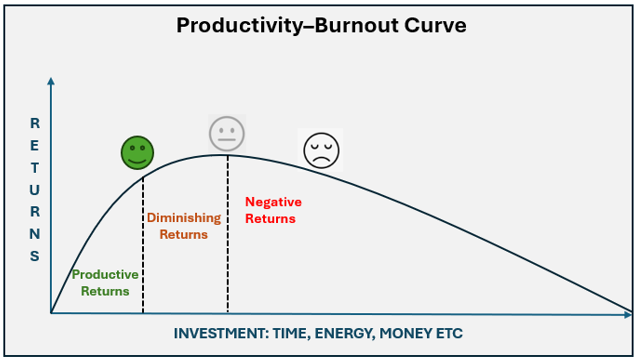
In practice, one of the most significant challenges we face is recognising that this limit exists within all of us. Many people operate under the quiet but persistent assumption that sustained or increased effort will always lead to better outcomes. It’s a common belief, that is often reinforced by workplace culture and societal expectations. However, when this assumption goes unchallenged, it can lead us to override important internal signals. Fatigue, reduced concentration, irritability, and emotional withdrawal are often early indicators, yet they are easily dismissed because the behaviour itself—pushing harder—feels familiar and, in many contexts, rewarded.
Even when people begin to sense that something is no longer working, stepping back can feel surprisingly difficult. There is often a strong pull to continue the cycle of “just a little more,” driven by habit, responsibility, or external pressures that may not be entirely within one’s control. Over time, this creates a pattern where activity continues to increase, while effectiveness, satisfaction, and wellbeing quietly decline.
Recognising this pattern is not about reducing ambition or lowering standards, it is about understanding that sustainable productivity requires respecting limits. When we learn to pause at the right point, rather than pushing beyond it, we preserve both our capacity to function and our overall mental health.
Healthy versus unhealthy stress
In the 1930s, Hungarian medical researcher Hans Selye introduced the concept of General Adaptation Syndrome (GAS), as one of the earliest attempts to explain how the body responds to stress. His model described three stages:
- Alarm – the initial “fight-or-flight” response, where the body releases stress hormones and mobilises energy to deal with an immediate challenge.
- Resistance – if the stress continues, the body tries to adapt and stabilise itself while staying on alert. During this stage, manageable amounts of stress can strengthen our ability to cope, building resilience over time.
- Exhaustion – when stress is prolonged and chronic in nature, and there is no opportunity for recovery, the body’s resources become depleted, increasing the risk of burnout, fatigue, and illness.
Selye also made an important distinction between harmful stress and what he called eustress, or “positive stress.” This type of stress can feel energising and motivating, and help us grow, perform, and adapt to challenges.
While Selye’s model remains influential, our understanding of stress has evolved. We now recognise that stress is not simply a three-stage process, but a complex, whole-body response involving the brain, nervous system, and hormones—particularly the hypothalamic–pituitary–adrenal (HPA) axis. This system helps regulate the release of stress hormones like cortisol, shaping how we respond to both immediate challenges and ongoing pressures. When this system is well-regulated, stress can be helpful and adaptive; however, when it remains overactivated for extended periods, it can contribute to a range of physical, emotional, and relationship issues.
Because these responses can become deeply ingrained and difficult to recognise on your own, working with a Psychologist can be a valuable step. Psychological support can help you identify your unique stressors, understand how your body and mind are responding, and develop more sustainable, manageable ways of coping.
Take the next step—break free from the productivity trap by reaching out to a Psychologist today
The psychology behind the words we use every day has a powerful influence on our behaviour, actions, and how we see ourselves and others. But change starts with awareness. It requires us to recognise, reframe, and retrain the belief that being “busy” is something to strive for. Instead, begin defining your own markers of healthy stress, so you can function at your best—both sustainably and intentionally.
If you’re ready to move beyond the productivity trap and find your healthy balance, reach out to Psychologist, Helen Handsjuk today and take that first step.